
Sarah Way and Lance Lloyd

Figure 1. The Winton wetlands has been returned to its natural hydrology of wetting and drying. It is considered to contain suitable natural and recovering habitats for the future breeding and survival of the Growling Grass Frog (Litoria raniformis) which was last recorded in the area in 1970. Should the reintroduction be successful the positive impact may in time go well beyond Winton Wetlands. (Photo Winton Wetlands Committee.)
Winton Wetlands (Fig. 1) is located in the agricultural landscape of north-eastern Victoria. It holds significance as the traditional lands of the Yorta Yorta people; as former grazing country for local settler communities; and, as a wetland supporting high biodiversity. However, the past 50 years of its history have been marked by ecological degradation caused by the permanent flooding of the wetlands for irrigation water storage between 1968 and 2009 (Fig. 2). Since the decommissioning of Lake Mokoan in 2009, however, the site has been managed for the conservation of environmental and cultural heritage. Today, Winton Wetlands stands as a beacon of hope for long-term wetland restoration within an agricultural landscape.
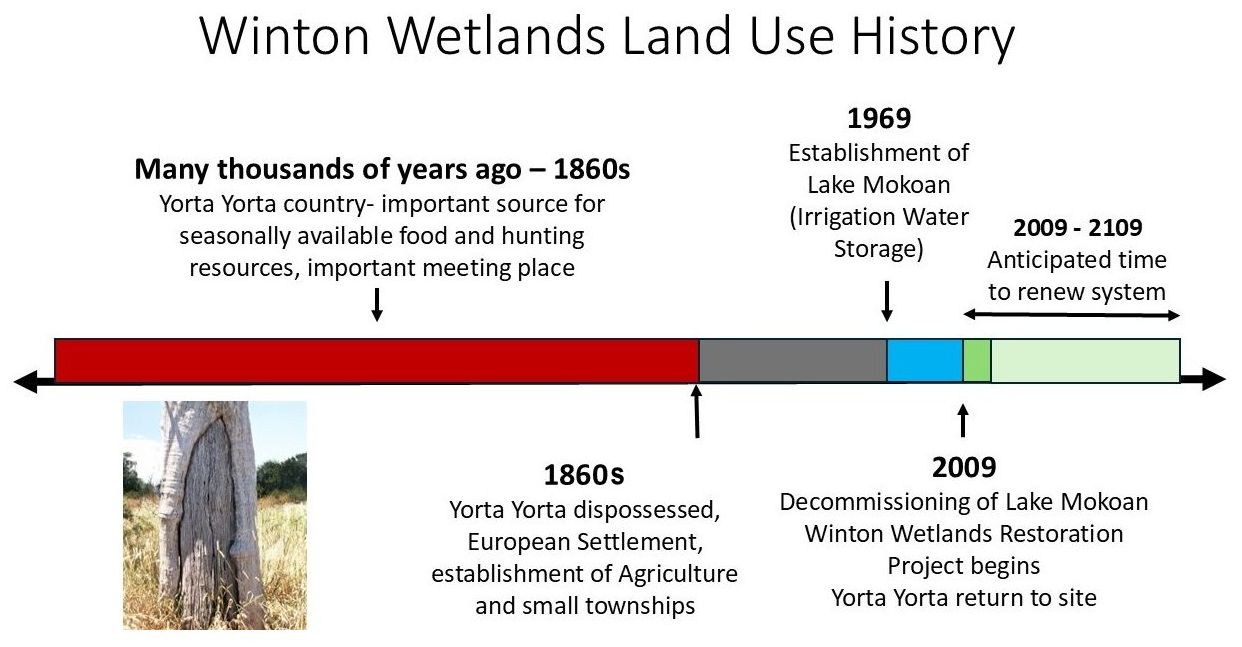
Figure 2. The Winton Wetlands have a history of both benign and problematic management including a period of permanent flooding of the wetlands for irrigation water storage between 1968 and 2009. (Diagram: Dr Lisa Farnsworth, Winton Wetlands)
The 2011 Winton Wetlands Restoration and Monitoring Strategic Plan (the Plan) recorded ten frog species in the area. However, the Growling Grass Frog (Fig. 3)—listed as Vulnerable nationally under the EPBC Act 1999 and in Victoria under the FFG Act 1988—had not been recorded at the site since 1970. This coincides with the beginning of the Lake Mokoan era (see Fig. 2), which also marked a significant decline in the species detection across northern Victoria, especially in the past 20 years.
The loss of the Growling Grass Frog is believed to have contributed to the decline of other native species in the area, particularly birds that once preyed on them. The Plan notes that the return of this species, with its distinctive and easily identifiable call, would be a major step toward restoring the ecological function of the wetland ecosystem. As part of the restoration program, the science team (with support of the Committee of Management) proposed in 2017 to reintroduce the threatened Growling Grass Frog to Winton Wetlands.
The species. The Growling Grass Frog is a large, charismatic species, functionally distinct from other local frogs. That is, it functions not only as prey (being targeted by the threatened Australasian Bittern, Botaurus poiciloptilus, and similar predatory waterbirds due to its larger size) but it also predates on insects and other frogs. It cannot naturally recolonise Winton Wetlands due to its distance from the nearest known populations (200km), but herpetological experts and our own investigations have identified the site as a strong candidate for reintroduction. If successful, the reintroduction may support not only local restoration but also broader efforts to reverse the species decline across its former range in northeast Victoria.
What does the species need? Like other frogs, the Growling Grass Frog requires aquatic vegetation for breeding and refuge—ideally including a good mix of submergent, emergent, and floating vegetation. It also needs basking sites (such as rocks) to help reduce the effects of chytrid fungus (Batrachochytrium dendrobatidis), as well as access to food sources including insects, other frogs, fish, and small lizards. The species thrives in permanent, preferably warmer, slightly saline water and requires protection from invasive fish species such as Carp (Cyprinus carpio) and Eastern Gambusia (Gambusia holbrooki).

Figure 3. The threatened Growling Grass Frog (Litoria raniformis) which was last recorded in the area in 1970, is now the subject of a reintroduction program at Winton Wetlands. (Photo Bob Winters.)
Gaining permits for reintroduction. The presence of these elements alone is insufficient to make a strong case for obtaining the necessary translocation permit (Victorian legislation) and EPBC Act referral. To make a strong case, the translocation panel and EPBC required proof of absence from the site, evidence that removing a cohort from a source population would not harm that population, provision of an appropriate captive breeding and quarantine facility onsite, as well as evidence of threat reduction/mitigation and suitable habitat at our wild release sites.
Progress so far. These milestones were achieved over an 8-year period with significant inputs from an army of enthusiastic project advocates and supporters at every stage.
Stage 1 (2017/2018) involved the development of the project’s Feasibility Study, which determined it was theoretically possible to establish a new population at Winton Wetlands.
Stage 2 (2020-2022) focusing on the development of the quarantine and captive breeding facilities (Fig 4.), procedures and protocols and the acquiring of licences and permits. Studies were also done on the background genetics required for the breeding program. During Stage 2, Taskforce Growler was also launched, followed by release site habitat enhancement. Taskforce Growler is a key element of the program as it is a community-driven alliance between members of the public, wetland scientists and land and water managers across the region, working together in a coordinated effort.
Stage 3 (2023-2024) saw the translocation of first cohort from the source site to the on-site quarantine laboratory (in March 2023), with that cohort ‘soft’-released into an outdoor breeding facility in October 2023. Further enhancements were made to the release site habitat. The first wild release of broodstock raised in the captive breeding program will occur following the first successful breeding. Although breeding behaviour has been observed in two past breeding seasons, successful breeding has not yet been detected in the captive breeding facility.
GGF Practitioners Network
Winton Wetlands have so far convened three online gatherings – Practitioners’ Network meetings – in an ongoing series to bring together Australia’s leading figures in the protection and restoration of the Growling Grass. Participants include people from the five states of the species’ range and from a variety of sectors including universities, government agencies and community groups. The aims are to share information about how best to conserve this threatened species and to hear about current projects and how to return the species successfully to locations where it has become locally extinct.

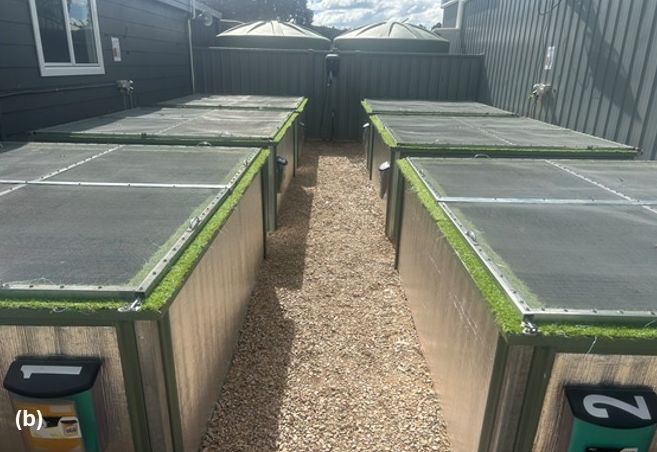
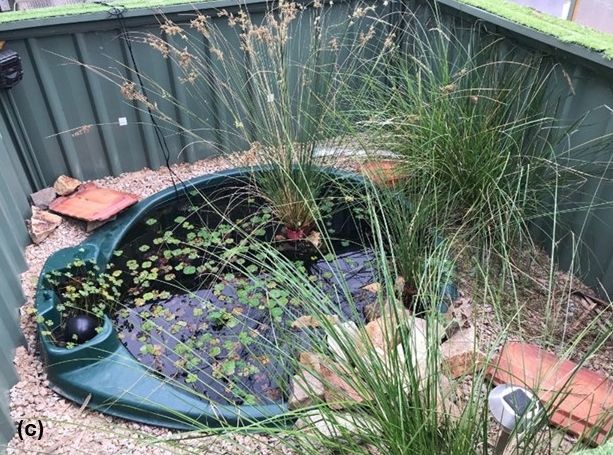
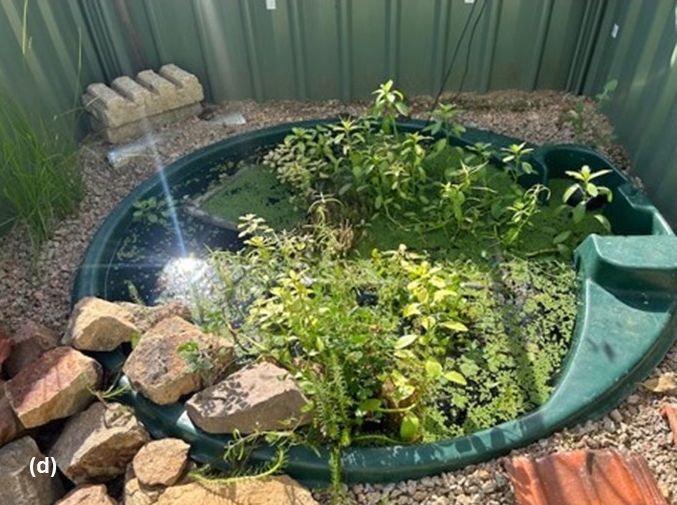 Figure 4 a-d. The on-site laboratory (a) and captive breeding facilities (b-d)
Key lessons. Taskforce Growler has proven to be a highly effective way of involving grass roots volunteers, who helped to provide vital evidence and support for the project. The increased local ownership has encouraged greater connection to the site and to the species. The rewilding project has also benefited from generous expert advice on the species that has provided flexibility and confidence to break new ground. The sustained effort and collective support has strengthened the project’s funding bids.
Future directions. Should the project’s breeding program and future first wild release be successful, annual releases are anticipated thereafter. Work has already been undertaken to increase capacity of the breeding facility to accommodate ‘grow out’ ponds, thanks to funding from Wettenhall Environment Trust. The installation of hot and salty day spas in the breeding pods have helped reduce the risk from chytrid infections. A video feed from cameras in the breeding pods, installation of interpretation displays in our Café and further volunteer training will increase community involvement in the project.
Acknowledgements. Thanks to the multiple project funders and partners – Wettenhall Environment Trust, the Ross Trust, Coliban Water, Biosis, Goulburn Broken CMA, Yorta Yorta Nation Aboriginal Corporation, Taskforce Growler, Swamps Rivers Ranges, North East and North Central CMAs, DEECA, DCCEEW, Nature Glenelg Trust, MDBA, Museums Victoria, Air Seed, Frog ID, & OZmist. Also many people have contributed to this journey and they include Lisa Farnsworth who co-initiated the project, Drs Geoff Heard and Matt West who have been long term advisers and various Winton Wetlands Volunteers (too many to name).
Contacts: Sarah Way (Sarah.Way@wintonwetlands.org.au) and Lance Lloyd (Lance.Lloyd@wintonwetlands.org.au), Winton Wetlands Committee of Management, 652-668 Lake Mokoan Road, Chesney Vale, Victoria, 3725, Australia.



 EMR Project Summaries